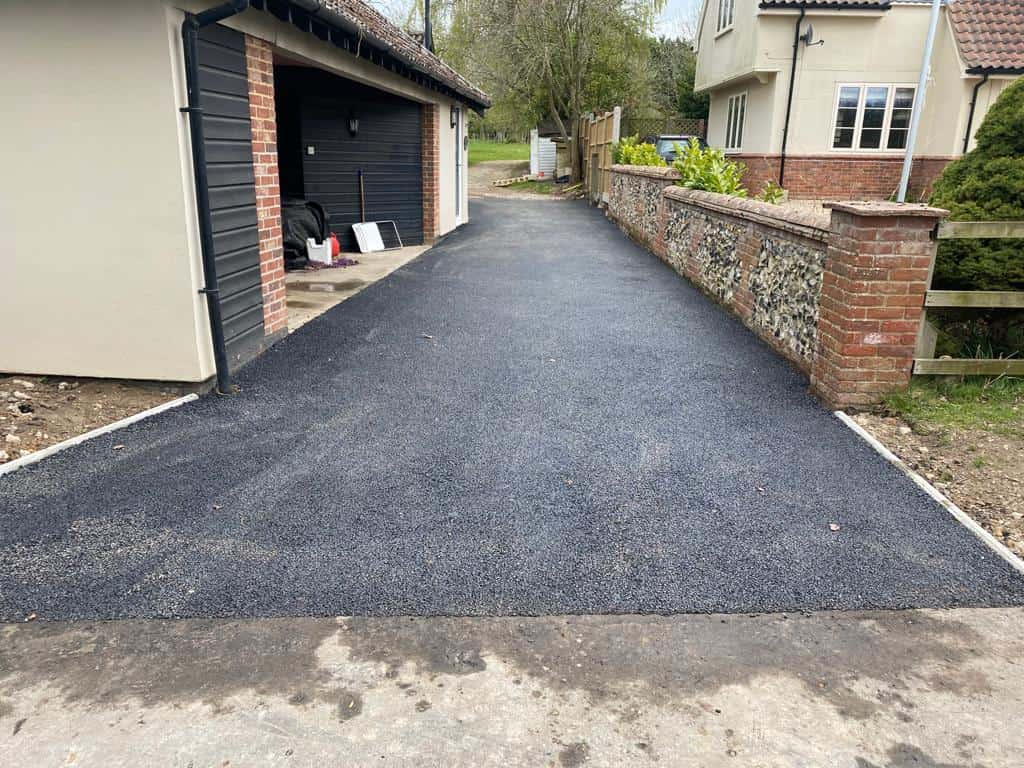
Why Is Tarmac Ideal for Replacing a Patchy Driveway?
A driveway can become patchy after years of localised repairs, weathering and repeated vehicle use. Sections may differ in colour, texture and level, while cracks or depressions continue to develop around earlier repairs.
For homeowners in Newmarket, Suffolk, professionally installed tarmac can replace this inconsistent surface with a smooth and practical driveway. Its success, however, depends on identifying why the original surface deteriorated and correcting any weaknesses beneath it.
How Tarmac Can Transform a Patchy Driveway
Tarmac forms a continuous, compacted surface that works well across both simple and irregular driveway layouts. When supported by a stable sub-base, secure edges and correctly planned drainage, it provides a dependable finish for regular vehicle use.
It Creates a Consistent Surface
A driveway made up of several repaired sections can become uneven and visually disjointed. Individual patches may have been completed at different times using materials that have weathered differently.
Replacing the worn surface with tarmac creates a more uniform appearance across the complete driveway. It also removes abrupt transitions between old repairs, loose areas and surrounding sections.
The result is a cleaner surface that feels more consistent when driving or walking across it.
It Provides an Opportunity to Repair the Foundation
Patchy deterioration is not always limited to the visible surface. Repeated cracking, sinking or crumbling may indicate that parts of the sub-base are weak, shallow or inadequately compacted.
Before new tarmac is laid, the existing driveway should be assessed for:
- soft or moving sections
- sunken wheel tracks
- loose surface material
- unstable edges
- deep cracking
- areas affected by standing water
- previous repairs that have failed
Unsuitable material can then be removed and the supporting layers rebuilt where necessary. This preparation helps prevent old defects from transferring into the new surface.
It Can Correct Uneven Levels
A heavily patched driveway may contain dips, raised repairs and poorly matched connections. These irregularities can make vehicle access uncomfortable and allow water to collect.
During replacement, the driveway can be formed to create smoother transitions around entrances, garages, paths and other adjoining surfaces. Correct levels also help water move towards the intended drainage points.
Tarmac can accommodate gradual changes in gradient, making it suitable for driveways that are not completely flat.
It Supports Effective Water Management
Water collecting around old patches can enter cracks and weaken loose material. As the affected sections deteriorate, depressions may deepen and create further standing water.
A new tarmac installation allows drainage to be considered across the whole driveway rather than around one repaired area at a time. Suitable falls can be created, and any required channels or outlets can be incorporated into the design.
Correcting drainage during construction is important because a smooth new surface cannot compensate for unsuitable underlying levels.
It Performs Well Under Regular Vehicle Use
Vehicle weight, steering and braking place repeated pressure on a driveway. Turning areas, parking positions and narrow entrances often deteriorate first when the construction below them is weak.
A correctly installed tarmac driveway distributes these loads through its compacted layers. The continuous surface avoids many of the loose boundaries that can develop between separate repair patches.
Additional attention can be given to frequently used areas so that the construction reflects how vehicles move across and park on the driveway.
It Works With Different Driveway Shapes
Tarmac can be laid across straight, curved and irregular areas. This makes it useful where a driveway narrows near the entrance, widens for parking or connects with several paths and access points.
Defined kerbs or block edges can be used to:
- retain the tarmac securely
- create clean boundaries
- separate the driveway from planting
- protect vulnerable edges
- highlight curves or changes in direction
Well-planned edges support the surface structurally as well as completing its appearance.
It Can Replace Numerous Temporary Repairs
Localised repair remains appropriate when damage is confined to one stable section. However, continuing to patch a driveway that is failing in several places can result in an increasingly uneven surface.
Replacement may be more suitable when:
- cracks appear around multiple repairs
- separate areas are sinking
- the surface is breaking up generally
- water collects in several depressions
- patches repeatedly become loose
- levels vary across the driveway
A complete assessment can determine whether all of the existing construction needs replacing or whether stable sections can be retained beneath a resurfacing system.
Resurfacing or Full Reconstruction?
Some patchy driveways remain structurally stable beneath the worn upper layer. In these cases, preparation and resurfacing may provide an effective solution.
Full reconstruction may be needed where the driveway has widespread movement, substantial settlement or an inadequate sub-base. Simply covering these problems with new tarmac can allow cracks and dips to return.
The choice should be based on the condition of the supporting layers rather than appearance alone.
Why Professional Installation Matters
Tarmac must be laid at suitable thicknesses and compacted while the material remains workable. Preparation, edge restraint, drainage and connections with existing surfaces must all be completed accurately.
Professional installation brings these stages together. It ensures that the new surface is designed around the ground conditions and expected use of the driveway rather than serving only as a cosmetic covering.
Conclusion
Tarmac is a strong choice for replacing a patchy driveway because it creates a continuous finish, supports regular vehicle use and can accommodate varied layouts. It also provides an opportunity to correct uneven levels, drainage problems and weak areas beneath previous repairs.
The condition of the existing foundation will determine whether resurfacing or more extensive reconstruction is appropriate. If your driveway in Newmarket, Suffolk has become uneven or covered with failing patches, Newmarket Driveway Surfacing can assess the surface and recommend a suitable tarmac solution. Contact the team to arrange a professional evaluation.
Call us on: 01638 591 795
Click here to find out more about Newmarket Driveway Surfacing
Click here to complete our contact form and see how we can help with your driveway needs.